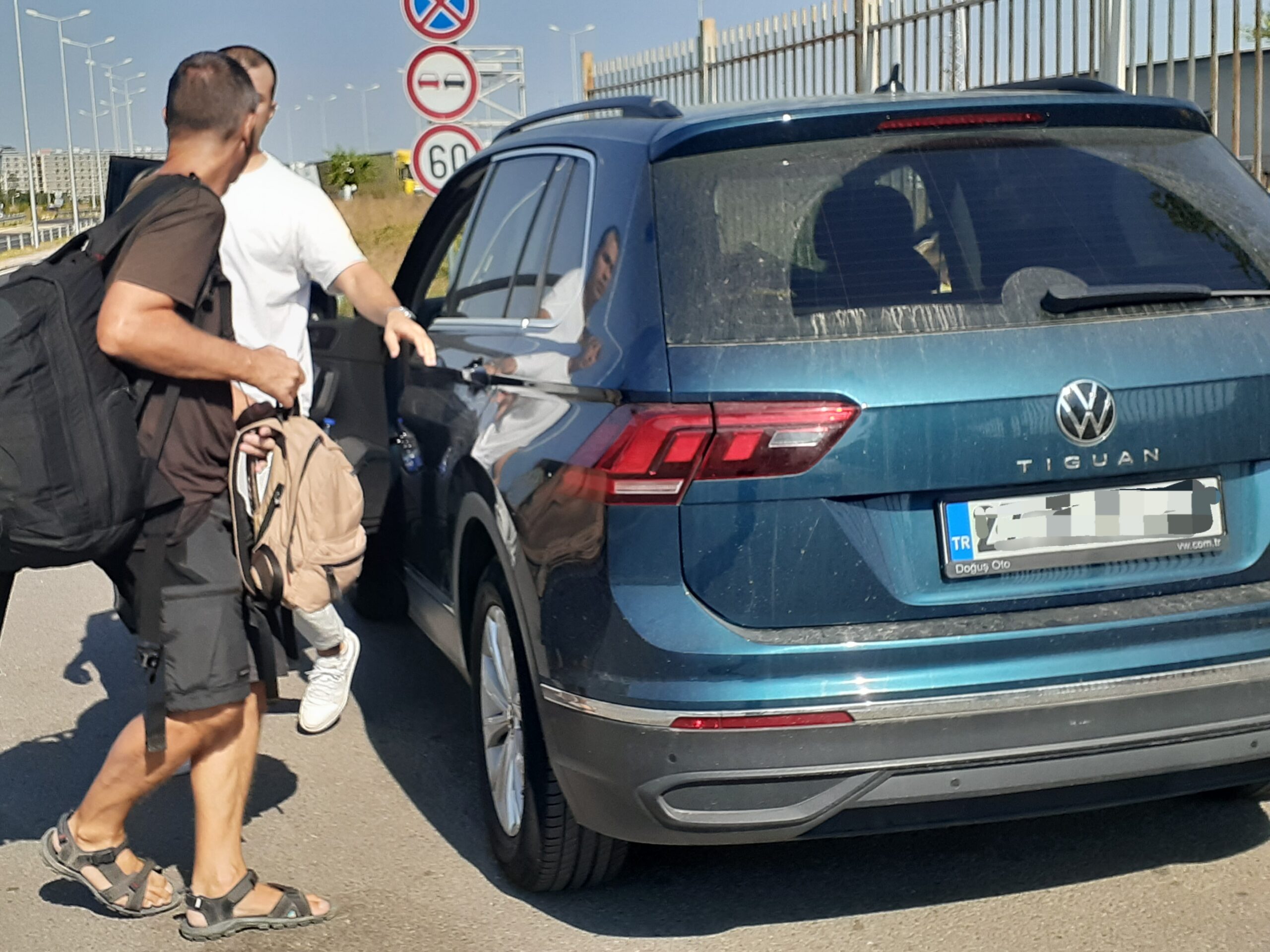
When travelling overland from Edirne, Turkey, to Plovdiv, Bulgaria, there is one critical rule every backpacker and independent traveler must know: the Kapıkule border checkpoint is strictly a vehicle-only crossing, and crossing on foot is completely forbidden.
During our summer travels in 2023, a sudden hotel Wi-Fi crash left us without internet access the night before our journey. Ignorant of this strict regulation, we confidently headed to the frontier on foot, only to be stopped by armed guards and faced a tricky situation. In this practical guide, we’ll share our firsthand experience navigating the Kapıkule border, including how to take the local minibus from Edirne, and real-world tips for “border hitchhiking” to secure a lift across. If you know what to expect, a smooth journey to the beautiful, ancient city of Plovdiv awaits you on the other side.
🇯🇵 この記事を日本語で読む: 【実体験】トルコからブルガリアへ徒歩で国境越えはできる?カプクレ(Kapıkule)国境の罠とエディルネ発プロヴディフ行きドラマチック陸路ガイド
Edirne to Plovdiv Border Crossing: Quick Summary
- Border Checkpoint: Kapıkule (Turkey) / Kapitan Andreevo (Bulgaria) — A major EU gateway.
- The Golden Rule: Pedestrian crossing is strictly forbidden. You must be inside a vehicle to pass passport control.
- Transportation: Local minibus (Dolmuş) from Edirne to the border costs 25 TL. No public transport exists on the Bulgarian side.
- Our Solution: Forced to hitchhike at both Turkish and Bulgarian immigration checkpoints to secure a lift across.
- The Kapıkule Border Checkpoint: An Unexpected Roadblock for Backpackers
- Navigating Public Transport: From Edirne City Centre to the Frontier
- Stopped at the Gates: Hitchhiking Through Turkish Passport Control
- Stranded at Customs: A Lesson in Border Patience
- Entering Bulgaria: Wandering into a Deserted Frontier
- A Fateful Connection and Arriving in Plovdiv
- Ready to Plan Your Plovdiv Itinerary?
The Kapıkule Border Checkpoint: An Unexpected Roadblock for Backpackers
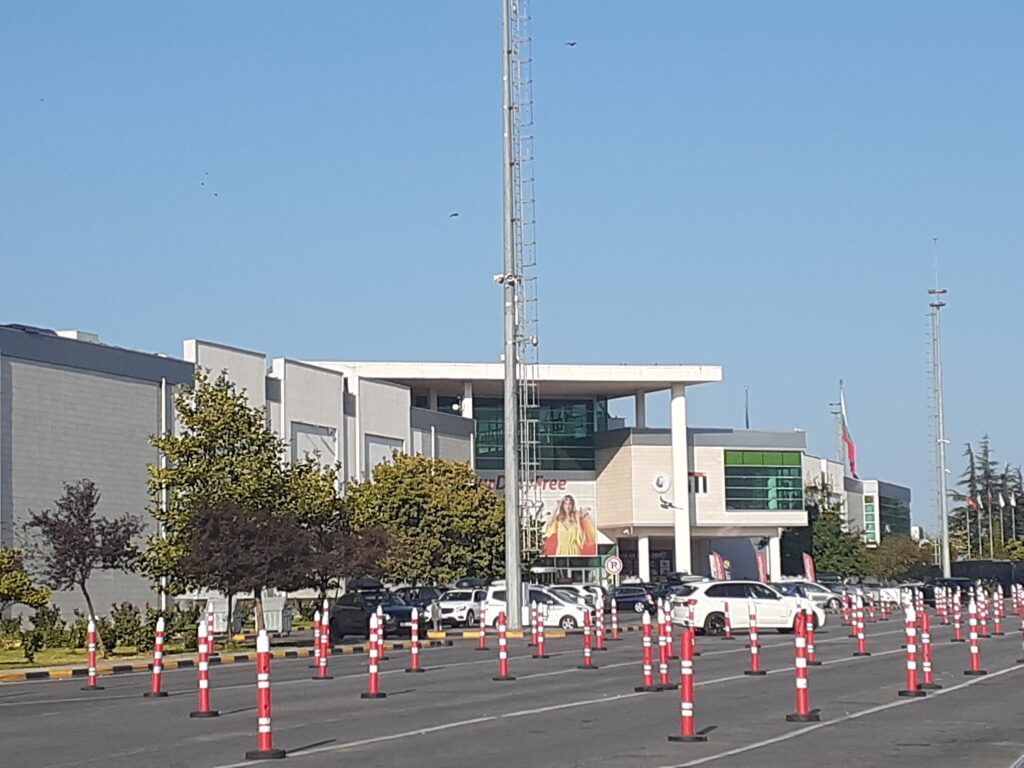
Our journey took us from the historic Turkish border city of Edirne, through the massive Kapıkule checkpoint, and onward to Plovdiv, Bulgaria. As a primary overland gateway between Turkey and the European Union, Kapıkule is a heavily trafficked, high-security border.
We attempted our crossing on Saturday, August 26th—the final weekend of the summer holidays. Anticipating a massive rush of families returning to Europe, we checked out of our Edirne hotel as early as possible.
However, we faced an immediate challenge: the hotel Wi-Fi had completely crashed the night before. Left with limited internet access, we couldn’t do our usual thorough research. Had we been able to Google the route, we probably would have discovered a critical rule: you cannot cross the Kapıkule border on foot. It is strictly a vehicle-only crossing.
Ignorant of this fact, we packed our bags and confidently headed to the border on foot, setting the stage for one of our most dramatic travel days yet.
Navigating Public Transport: From Edirne City Centre to the Frontier
The distance from central Edirne to the Kapıkule border checkpoint is roughly 20 km. While local information suggested that minibuses (Dolmuş) ran frequently, exact timetables were hard to pin down.
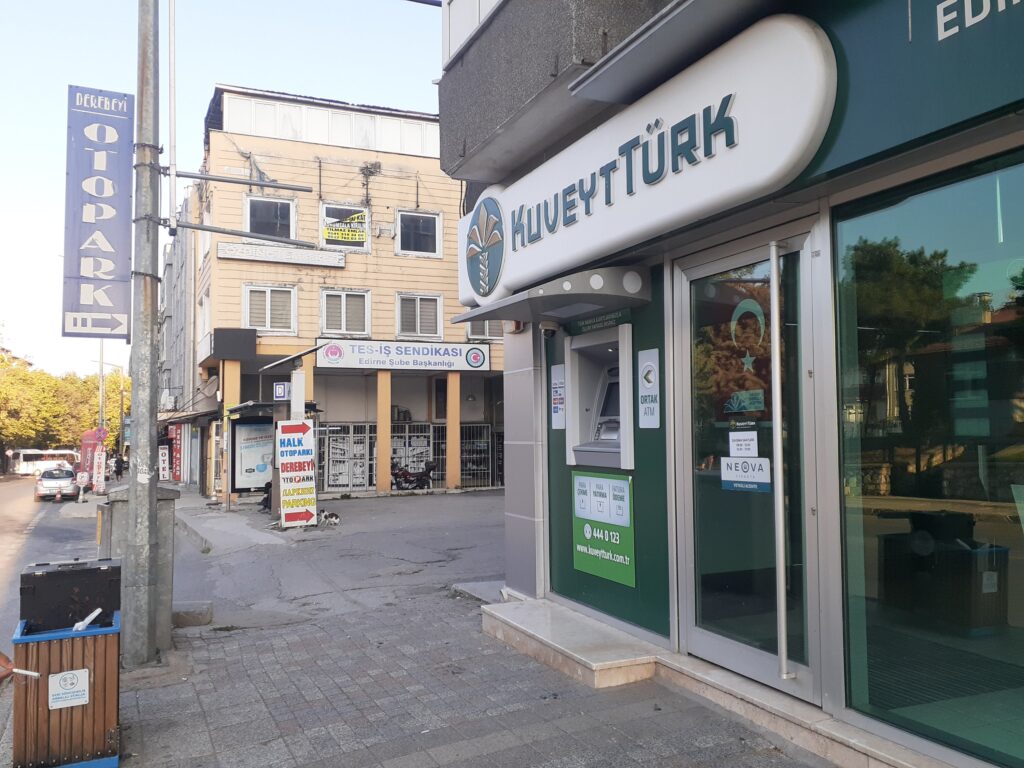
How to Find the Border Minibus in Edirne: The minibuses depart from Atatürk Street, which cuts directly through Edirne from east to west. We used Maps.me to locate the designated stop, which sits right in front of the Kuveyt Türk bank, close to the city bus station.
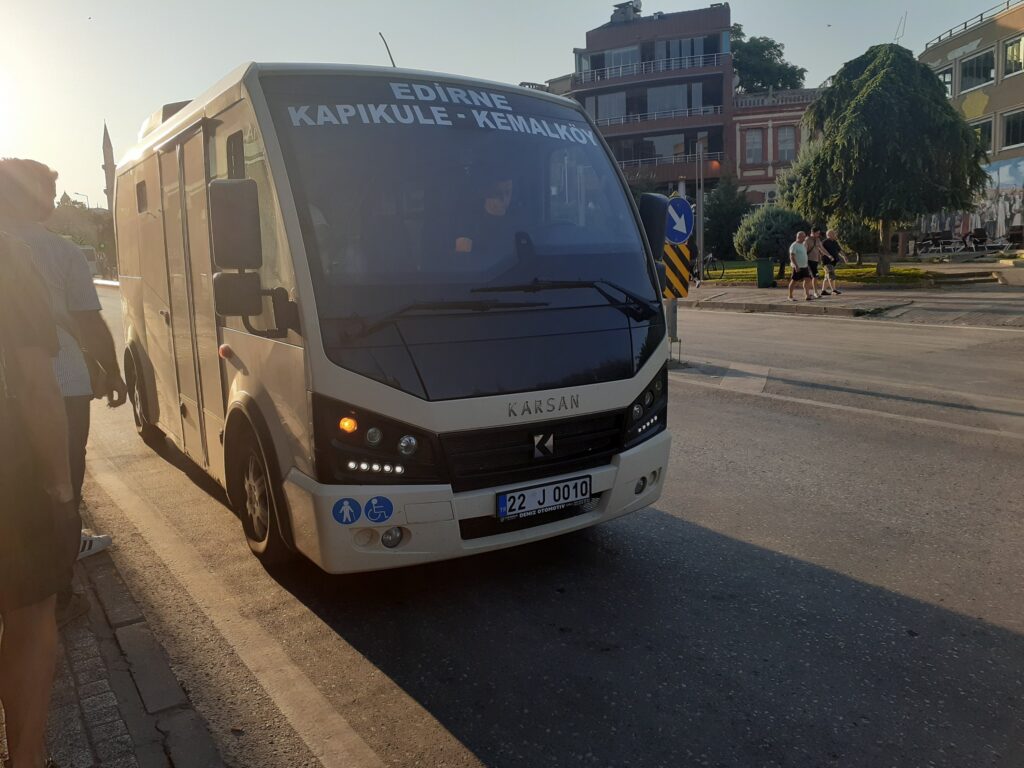
While waiting, we grabbed a couple of fresh simit (Turkish sesame-crusted bread rings) from a small street cart next to the nearby pharmacy. At exactly 7:40 AM, our minibus arrived. The fare was good value at 25 TL per person, and the smooth ride dropped us off right at the gates of Turkish customs in just 20 minutes.
Stopped at the Gates: Hitchhiking Through Turkish Passport Control
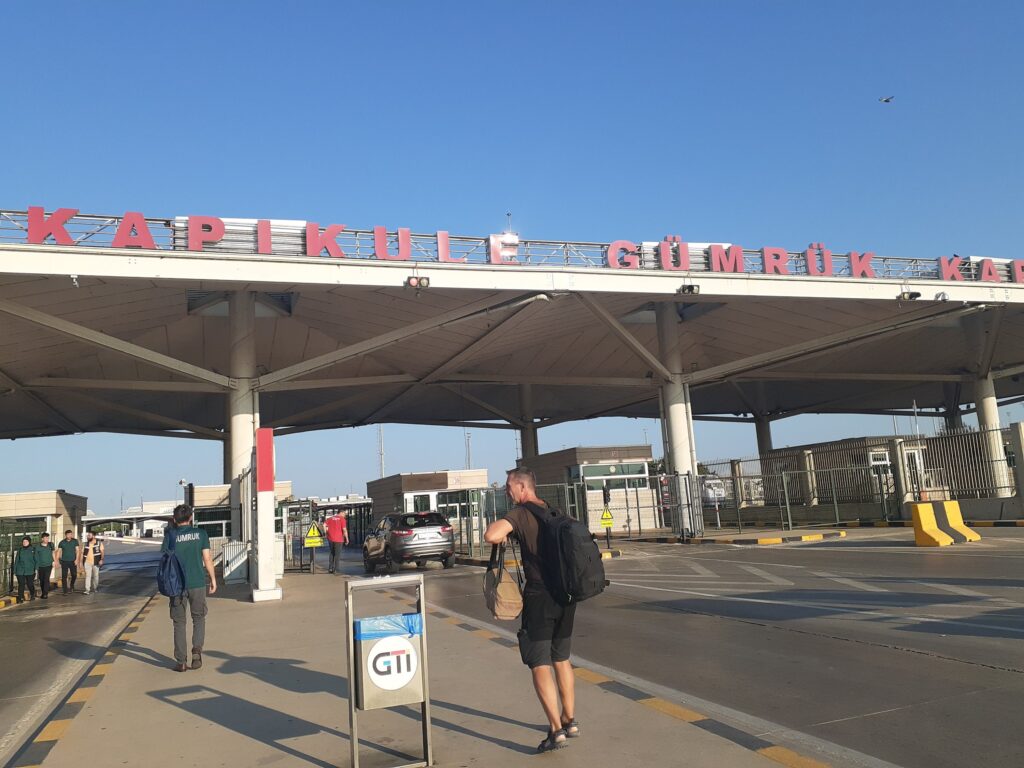
The moment we stepped off the minibus and began walking toward passport control, our journey ground to a halt. Armed border guards immediately intercepted us, shaking their heads. “Vehicles only from this point onward. No walking.”
We could see the passport booths just a few metres away, but we were legally barred from walking to them. With no public transport available to shuttle pedestrians across, we had only one option: we had to hitchhike right at the border entrance.
Traffic was dense, packed into narrow, walled vehicle lanes. We began flagging down every passing car, asking for a lift across the short gap. Because of the high-security nature of an EU border, driver after driver refused us. It was completely understandable—no one wants to pick up random foreigners when facing strict international customs checks.
We intentionally avoided cars packed to the brim with Turkish families and focused on vehicles with visible space. Finally, a kind Turkish man driving a car with Austrian licence plates pulled over. After we explained that we literally just needed a lift to the passport booth a few metres away, he unlocked the doors and let us in.
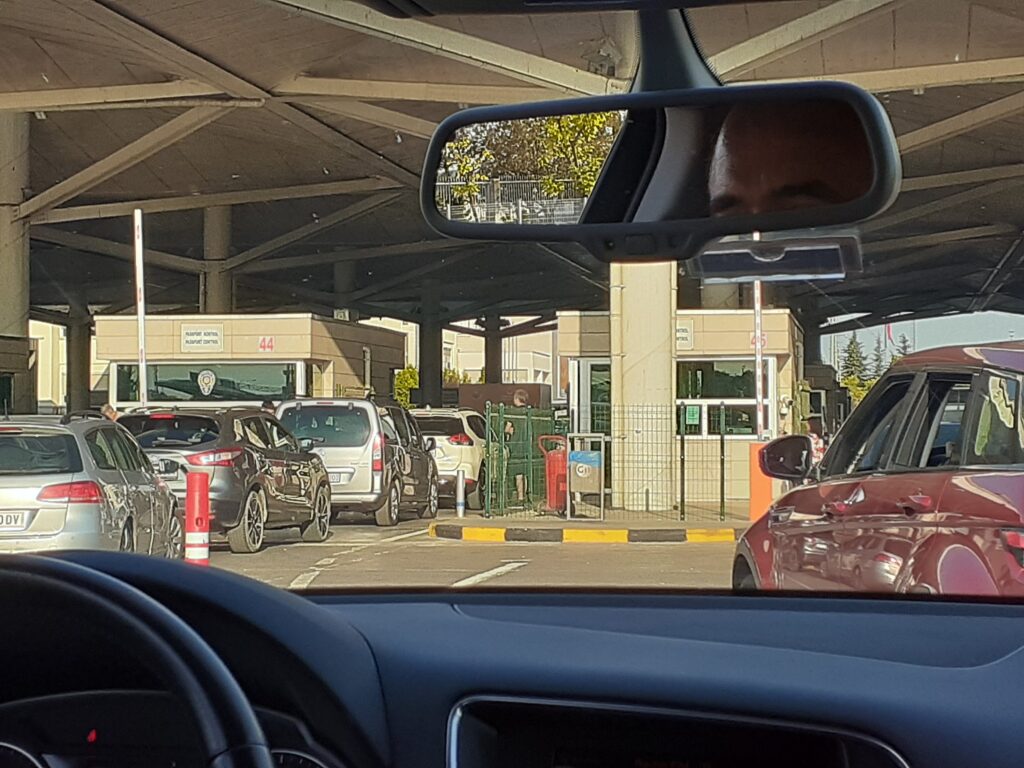
Thanks to him, we reached the vehicle lane for passport control. When our turn came, we stepped out briefly to present our passports. The border official took our photos via the booth camera and stamped us out. No questions asked—it was completely seamless.
Stranded at Customs: A Lesson in Border Patience
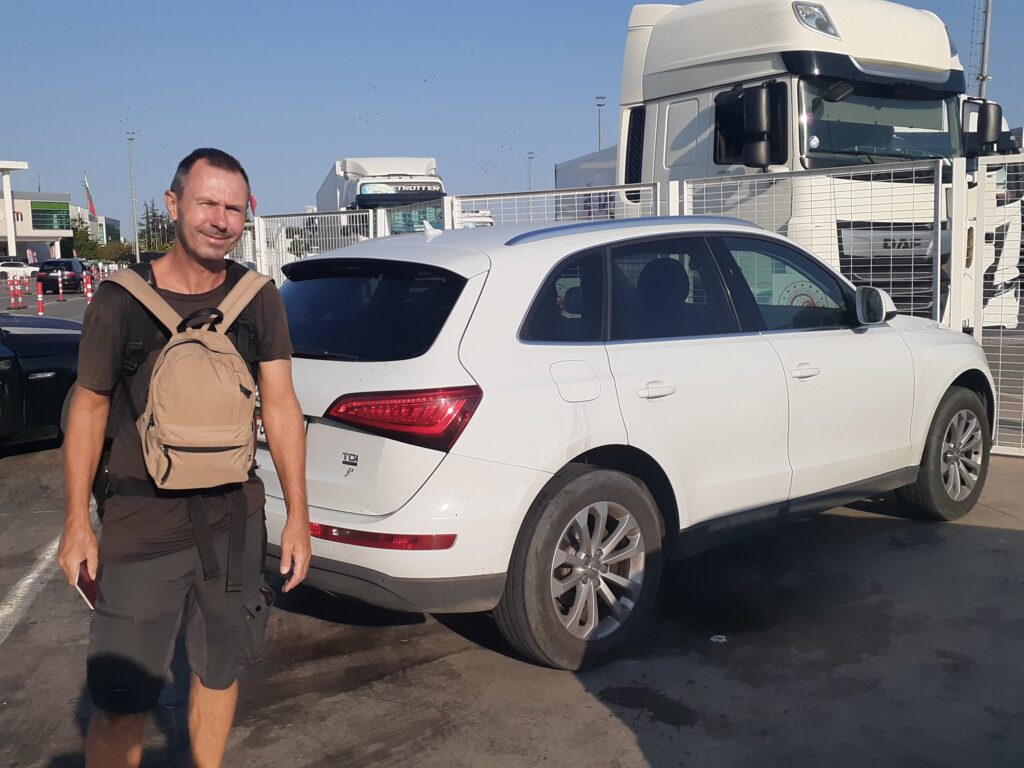
Just when we thought the drama was over, we hit a massive snag at the Turkish customs clearance loop. While our passports were perfectly fine, our driver ran into a major bureaucratic issue regarding his vehicle documents or personal belongings. He parked on the shoulder, told us he would be back in 10 minutes, and disappeared into the customs building.
Ten minutes stretched into an hour. Standing by the car, we debated our options. Our passports were already stamped out of Turkey, so we could technically walk away toward the Bulgarian side. However, we had no idea if there were taxis or buses waiting on the other side of no-man’s-land. We also held onto a sliver of hope that our driver might take us all the way to Plovdiv once he cleared customs.
After an hour, the driver finally emerged—only to walk right past us to enter the customs office on the entry side of the border. Realizing this would take hours, we decided we couldn’t waste any more time. Feeling incredibly sympathetic toward his situation, we left a note of thanks and began walking toward Europe.
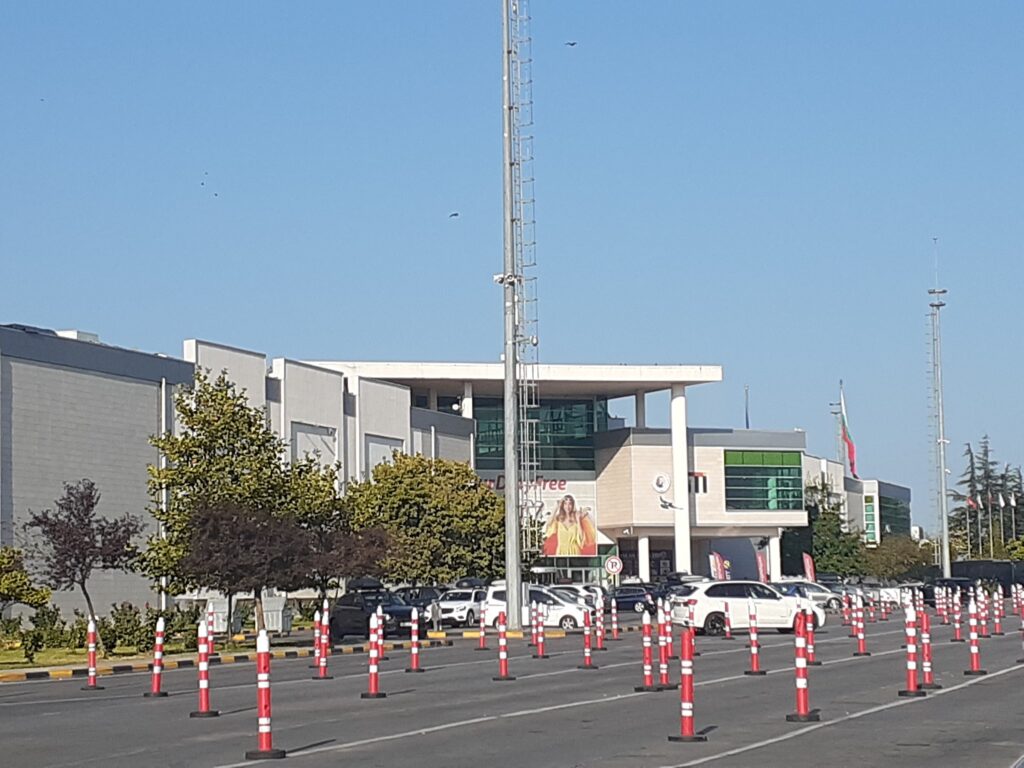
Walking the No-Man’s-Land Duty-Free Zone
Before officially entering Bulgaria, we passed through the central duty-free shopping complex located between the two borders. Here, I took the opportunity to exchange our remaining Turkish Lira (TL) into Bulgarian Lev (BGN) before heading to the EU gates.
Entering Bulgaria: Wandering into a Deserted Frontier
We walked right up to the Bulgarian passport control booths. Once again, the lanes were clearly designed only for cars. The border guards looked at us in absolute shock, asking, “Did you walk here?” We smiled, replied, “Yes, we walked,” and handed over our passports. Surprised but professional, they processed our documents and stamped us into Bulgaria.
Once through customs, we looked around and realized we were in trouble. Ahead of us lay nothing but a beautifully paved, empty motorway stretching out into deserted fields. No shops, no buildings, no taxis, and absolutely no people.
We asked a customs officer if there was a local bus or a Marshrutka (shared minibus) to the nearest town. He bluntly told us that the closest town was 15 km away, there was zero public infrastructure, and if we didn’t have a car, our only option was to start walking down the highway.
Stranded once more, we initiated Hitchhike Round Two. We stood at the singular vehicle exit of Bulgarian immigration, waving at the stream of cars passing through. Because this is the gateway to Europe, a steady parade of Euro-plated cars (German, Austrian, Bulgarian) rolled past.
After several rejections, we reminded ourselves to stay positive. Suddenly, a car pulled over. Inside was a young couple: Ali, a Turkish Airlines pilot who had coincidentally just flown back from Narita, Japan two days prior, and his Bulgarian girlfriend, Rina, a master’s student in finance.
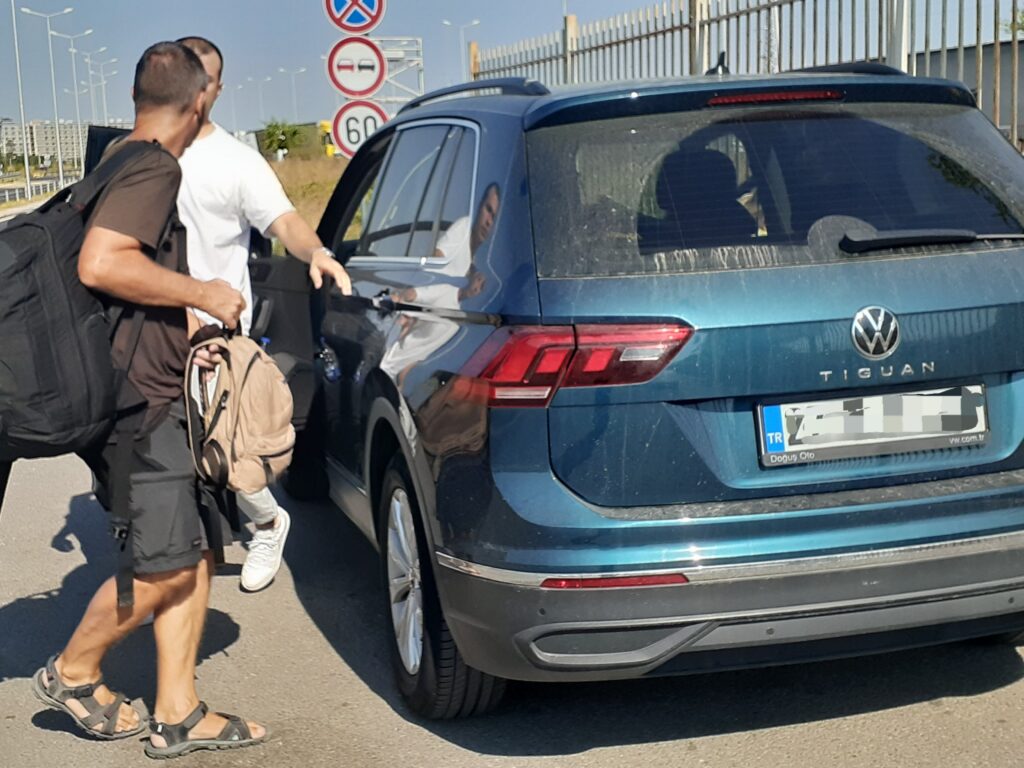
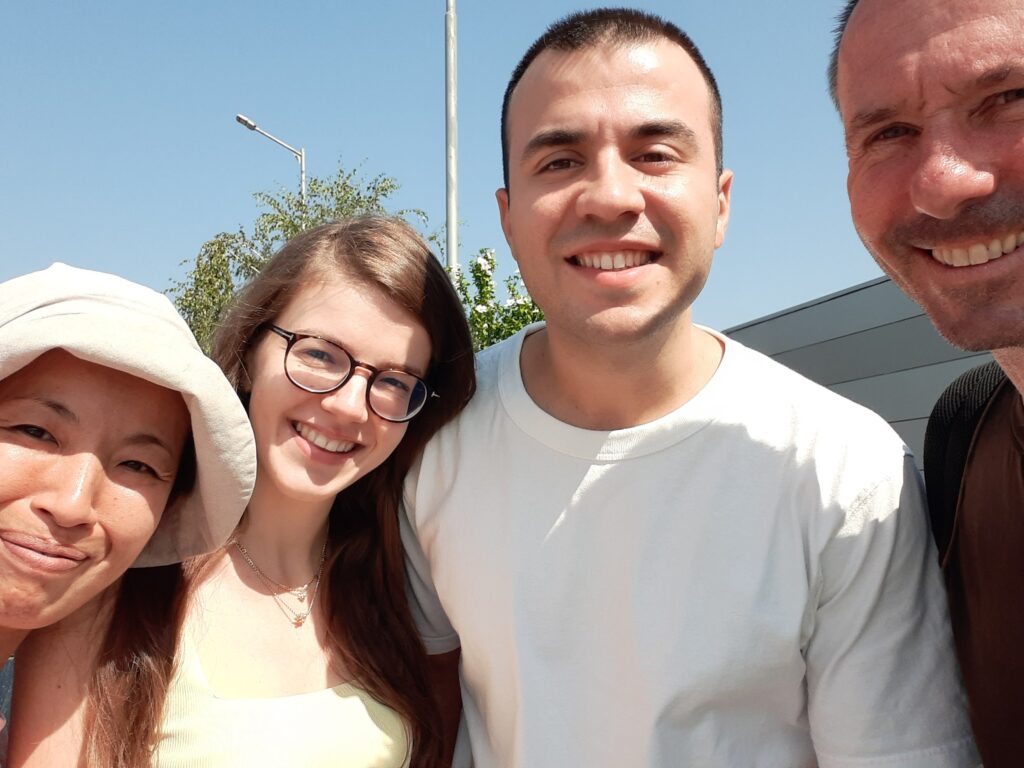
Discovering we had strong ties to Japan, Ali was ecstatic. He spent the drive praising Japanese culture, the food, and the kindness of the people. We countered by telling him that it was actually the incredible hospitality of Turkish people—just like him and our first driver—that had saved our journey today.
A Fateful Connection and Arriving in Plovdiv
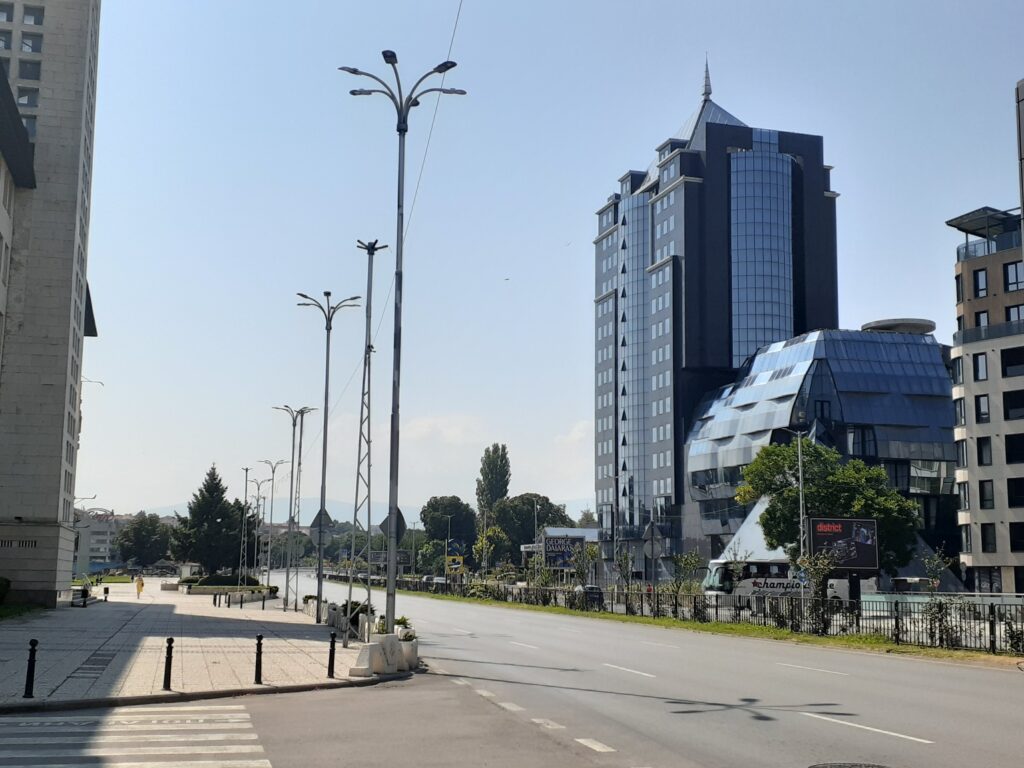
They treated us to fresh Bulgarian espresso along the highway and even gifted us local snacks as souvenirs. While Plovdiv wasn’t their original destination (they were heading to a nearby village), they incredibly went out of their way to drive us right to the edge of Plovdiv city centre.
Dropping us off safely near the heart of the city, we said our goodbyes. This was easily the most unpredictable, dramatic, and memorable border crossing of our entire trip. Turkish people helped us until the last stage of leaving the Turkish border. We felt sad and it was a shame to leave Turkey, but we need to move on. We have one month to go before returning to the UK and Canada via Bulgaria and Romania.
Ready to Plan Your Plovdiv Itinerary?
Thanks to the kindness of the Turkish people, we managed to make it into Bulgaria. We’re planning to enjoy plenty of sightseeing in Plovdiv. But before that, we bought a SIM card so we can get online whilst in Bulgaria.
➡ How to Buy a Prepaid SIM Card in Plovdiv, Bulgaria: Yettel Plans, Prices & Networks
Check out our comprehensive walking guide below, where we break down the absolute best sights, historical highlights, and a review of our favorite budget-friendly guest house:
➡ Next Post: Plovdiv Highlights: Best Sightseeing and Attractions in Bulgaria’s Ancient City

Comment