
Planning your next trip to the UK and wondering how to handle your smartphone’s data? In 2026, navigating London’s Tube or pulling up digital train tickets means a reliable internet connection is a must.
But should you buy a traditional physical SIM card at the airport, or opt for a modern digital eSIM downloaded before you leave home? And can you just get by on free café Wi-Fi?
In this guide, we break down the pros and cons of both options based on the latest travel standards. We’ll also share our own real-world strategy: my wife uses a brilliant global eSIM, while my phone is actually too old to support the tech—yet we stay seamlessly connected the moment we land via a clever hotspot workaround.
Whether you want ultimate convenience or the absolute lowest cost, read on to find the smartest way to power your UK adventure!
🇯🇵 この記事を日本語で読む: イギリス旅行のネット環境はどうする?eSIMと物理SIMを徹底比較
- Introduction: Navigating the UK’s Digital Landscape in 2026
- eSIM vs Physical SIM: A Quick Comparison for Travellers
- Going Digital: The Benefits and Pitfalls of Using an eSIM in the UK
- Going Traditional: When a Physical SIM Card Makes More Sense
- The Returning Traveller’s Trap: Can You Reuse Last Year’s SIM Card?
- Conclusion: Which Option is Best for Your UK Trip?
Introduction: Navigating the UK’s Digital Landscape in 2026
To understand why choosing the right data plan matters, it helps to understand just how “digital-first” the UK has become. Over the last couple of years, the country has rapidly phased out paper and cash in favour of digital alternatives. From tapping your phone at a London bus stop to scanning a QR code for a museum entry, a smartphone with an active data connection isn’t just a luxury anymore—it is your lifeline.
Why a Reliable Data Connection is a Travel Essential
When you are exploring the UK, things move fast, and the unexpected happens. Here is where having live data completely changes your travel experience:
- Real-Time Transit Updates: UK trains are notorious for sudden platform changes or short-notice delays. Apps like National Rail Enquiries or Citymapper give you instant alerts so you never miss a connection.
- Digital Booking & Discounts: Many of the best travel hacks, like the Two Travel Together Railcard (which saves couples 1/3 on rail fares), are entirely digital. You need to be able to pull up these apps and show your active digital pass to the ticket inspector on the go.
- Spontaneous Exploring: Finding a highly-rated local pub, booking a last-minute theater ticket in the West End, or using GPS mapping to navigate winding historical streets all require steady, reliable internet.
Can You Survive on Free Wi-Fi Alone in the UK?
A question we often hear from budget-conscious North American travellers is, “Can’t I just save my money and hop between free Wi-Fi networks at my hotel and Starbucks?”
The short answer is yes, you can. Free Wi-Fi is widely available across the UK—most pubs, cafés, and major train stations allow you to connect simply by entering your email address or signing in via social media. You don’t necessarily need a local phone number just to get online.
However, relying only on free Wi-Fi creates a few frustrating friction points during a busy holiday:
- The “Sign-In” Fatigue: Every time you enter a new station, pub, or coffee shop, you have to stop, wait for the pop-up screen to load, and fill out your details again. When you’re just trying to quickly check Google Maps while walking down a busy street, this lag is incredibly annoying.
- The Coverage Gaps: The moment you step out of the café and onto the pavement, your connection drops. If you need to re-route your walking directions or check a live bus arrival while standing at a rainy bus stop, free Wi-Fi won’t help you.
- Security Vulnerabilities: Entering your credit card details to book a spontaneous train ticket or checking your bank balance over an unsecured public network is a risk.
My wife and I made a rule long ago never to rely solely on public networks for our travel logistics—the seamlessness and security of having your own cellular data the second you step outside is worth every penny.
The Shift from Physical SIMs to eSIM Technology
Because constant connection is so vital, the way tourists get data has evolved. For a long time, the ritual involved stopping at a Heathrow Airport kiosk, buying a physical plastic SIM card, and carefully swapping it into your phone with a paperclip.
But as we move through 2026, eSIMs (embedded SIMs) have taken over as the modern standard. Instead of swapping physical cards, you simply buy a digital data profile online and download it straight to your device. It is faster, cleaner, and means you can keep your home phone number active in the background.
However, as we are about to explain, the “perfect” choice still depends entirely on your specific phone and your length of stay.
eSIM vs Physical SIM: A Quick Comparison for Travellers
Before we dive into the specific details of each option, let’s look at a quick, side-by-side comparison. This table highlights the fundamental differences in convenience, cost, and functionality to help you see which direction fits your travel style best.
| Feature | eSIM (Digital Download) | Physical SIM (Plastic Card) |
| Setup Time | Before you fly (at home) | After arrival (at a local shop) |
| Installation | Scan a QR code digitally | Swap manually with a SIM pin |
| Local UK Number (+44) | Rarely included on travel plans | Almost always included |
| Best For | Short-to-medium trips, convenience | Long-term stays, ultimate budget savings |
| Device Requirement | Modern, carrier-unlocked phone | Any carrier-unlocked phone |
| 2026 Availability | Instant via apps (like Airalo) | High street shops & supermarkets |
Key Takeaways from the Comparison
As you can see, the choice isn’t just about the technology itself—it’s about when and where you want to handle your logistics.
With an eSIM, you do all the “heavy lifting” (purchasing and installing the profile) from the comfort of your living room in North America. The moment the plane wheels touch the tarmac in the UK, your data switches on.
With a physical SIM, you save a bit of money on data packages and get a functioning local phone number, but you accept the trade-off of being digitally offline until you can walk into a Tesco or Boots in town to buy the plastic card.
Going Digital: The Benefits and Pitfalls of Using an eSIM in the UK
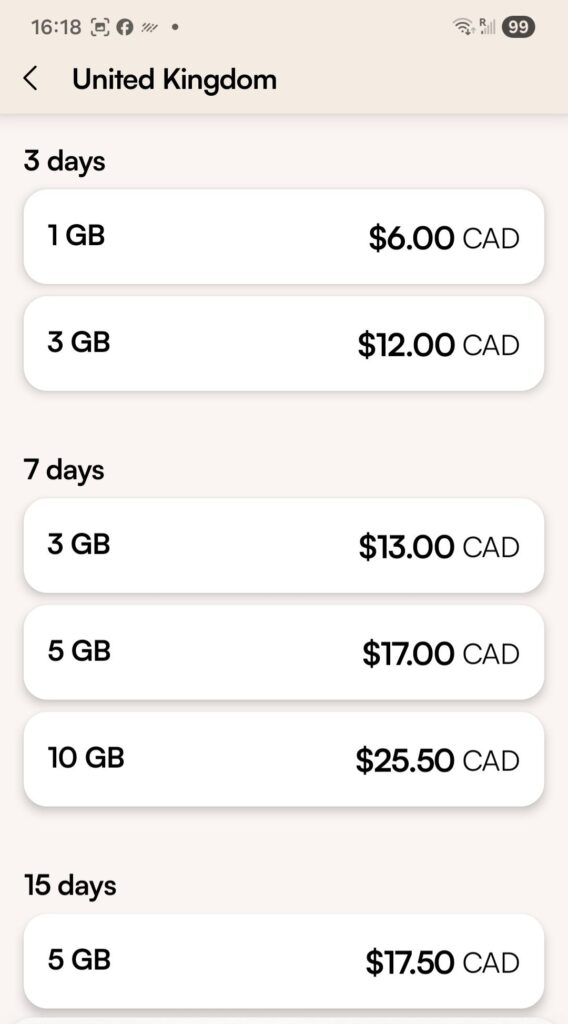
If you love the idea of stepping off the plane and being instantly connected without hunting down a mobile shop, an eSIM is likely your best bet. However, like any travel tech, it comes with its own unique set of advantages and compromises.
The Pros: Instant Connection upon Landing
The single biggest luxury of an eSIM is convenience. You can purchase your data plan online a few days before your trip, scan a QR code to install the profile while sitting on your couch, and leave it turned off. The moment your flight lands at Heathrow or Gatwick, you simply toggle the eSIM line on in your settings. Within seconds, you have local data to message family, check your hotel directions, or book an Uber.
Keep Your Home Number Active for Crucial SMS Verifications
Because an eSIM is completely digital, it leaves your phone’s physical SIM slot wide open. This means you can keep your home Canadian or American physical SIM card inside your phone active in the background.
Why does this matter? Security. When you travel, you will inevitably need to log into your online banking, your airline account, or a credit card app to approve a spontaneous purchase. These platforms almost always want to send a two-factor authentication (2FA) verification code via SMS to your home number. With an eSIM setup, you can receive those vital text messages for free while using your eSIM for all your heavy data usage.
The Cons: Data-Only Plans and the Lack of a Local UK Number
The main downside to most standard travel eSIMs is that they are data-only. They do not come with a traditional British phone number starting with +44.
While you can easily use WhatsApp or FaceTime for 95% of your communication, a lack of a local number can be a minor hassle if you need to call a traditional landline to make a dinner reservation at a busy London restaurant, or if a local boutique needs a contact number to hold an item for you.
The Pro-Tip (Untested by Us yet): How to Get a +44 Number via eSIM
While many generic tourist eSIMs are data-only, there is a workaround that some tech-savvy travellers use: you can technically get a local UK phone number starting with +44 on an eSIM before you leave North America.
Certain UK-based virtual networks—like giffgaff or Lycamobile—allow international tourists to download an eSIM profile via their apps while still at home, which supposedly assigns you a British mobile number.
A quick disclaimer from us: Because our own travel routine is locked into our trusted Airalo global plan, we haven’t personally tested these specific UK networks ourselves. We cannot verify how reliable their network speeds are across the country, or if the digital setup goes smoothly for international cards. However, if having a local +44 number is an absolute dealbreaker for your trip and you want to bypass the data-only route, it might be an option worth looking into and testing for yourself!
Key Requirements: Checking Your Device’s Compatibility Before You Fly
Before you get too excited about the digital route, there is a major catch: your smartphone must be carrier-unlocked and modern enough to support eSIM technology.
And this brings us to our own real-world strategy! Here is a confession from a travel blogger: my own trusted smartphone is unfortunately a bit too ancient to support eSIMs. But that does not stop us from travelling efficiently.
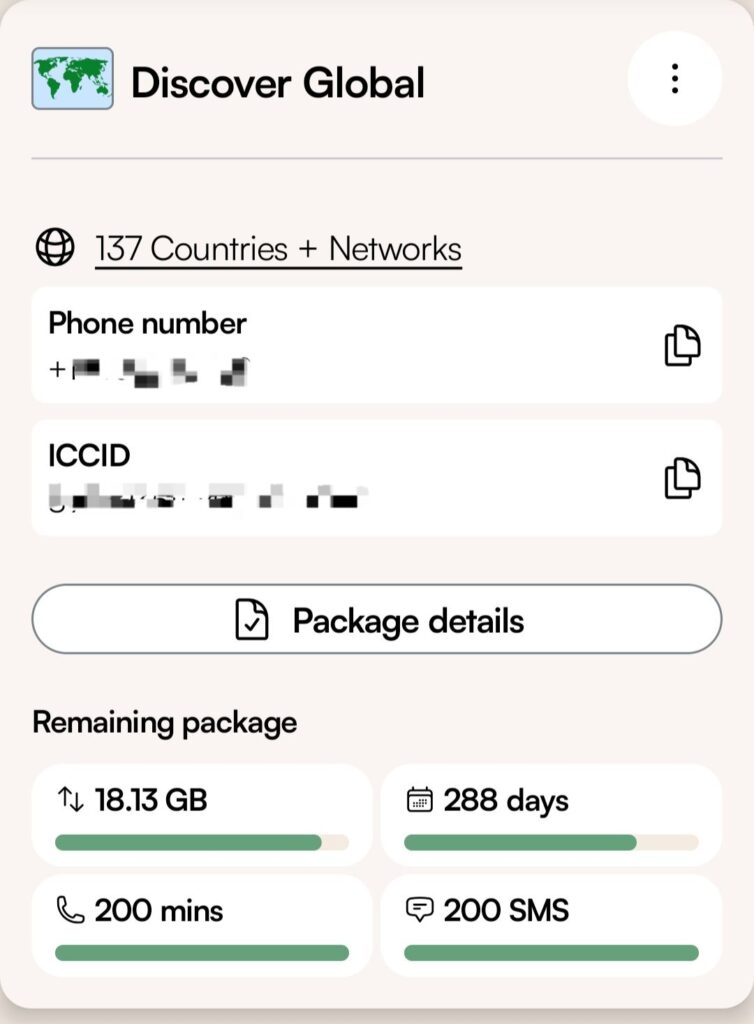
My wife’s phone is completely eSIM-compatible, and she uses the Airalo Discover+ Global eSIM. What makes this specific plan brilliant is that it actually includes a global phone number (starting with +1). It gives her seamless data access across over 120 countries—including our home base in Canada, the UK, Japan, and everywhere in between.
So, how do we handle my old tech? The second our flight touches down in the UK, her phone connects to the local network instantly. From there, I simply tether my old phone to her smartphone’s mobile hotspot. It is a flawless system: she gets premium global data, and I get a free ride on her high-speed connection without needing to upgrade my device. If you are travelling as a couple or a family where only one person has a newer phone, this hotspot workaround is an absolute game-changer.
Going Traditional: When a Physical SIM Card Makes More Sense
While eSIMs are incredibly popular right now, you should not automatically write off the traditional, physical plastic SIM card. In fact, depending on your device and how long you plan to explore the UK, going old-school can actually be the smartest financial decision you make for your trip.
The Ultimate Cost-Saver for Longer Stays
Let’s talk about money. If you are staying in the UK for more than two weeks—or if you are a heavy data user who loves uploading travel vlogs and photos on the go—physical SIM cards offered by local UK networks are almost always cheaper than tourist eSIMs.
The UK mobile market is fiercely competitive. Local networks offer “pay-as-you-go” monthly allowances designed for residents that tourists can easily buy. For example, a standard travel eSIM might give you 10GB or 20GB of data for a premium price. Meanwhile, walking into a local shop in London can easily get you a physical SIM card packed with 50GB, 100GB, or even completely unlimited high-speed data for a fraction of the cost. If you need a lot of data for a longer holiday, the cost-per-gigabyte savings of a physical SIM card are impossible to beat.
Getting a Local UK Number (+44) for Reservations and Peace of Mind
Unlike data-only eSIMs, every traditional physical SIM card sold on a UK high street comes with a fully functioning local British mobile number starting with +44.
Having a real phone number included in your plan gives you a massive safety net. It means you can easily make traditional phone calls to book a table at a popular countryside gastropub, call your boutique hotel if you are running late for check-in, or dial a local taxi service in rural areas where Uber doesn’t operate. Plus, if you need to register for local UK services or apps during your stay, you have a guaranteed number ready to accept local calls and texts.
Where to Buy Physical SIMs in London Without Paying “Airport Prices”
If you decide that a physical SIM card is the best fit for your budget, there is one golden rule you must follow: do not buy your SIM card inside the airport terminal.
The kiosks and vending machines inside Heathrow or Gatwick arrivals are notorious for charging inflated “tourist premium” prices for the exact same SIM cards you can buy down the street.
Instead, stay offline for your short train ride into central London. Once you are in the city, walk into any major supermarket like Tesco, Sainsbury’s, or Asda, or a high street pharmacy like Boots. You can find physical SIM cards from major budget networks like EE, Vodafone, O2, or giffgaff hanging on the racks right by the checkout registers. They usually cost around £1 to £2 for the plastic card itself, and you can easily load them up with a massive data package right at the counter or via the network’s app. It takes an extra hour of patience, but it will save you a significant amount of pocket money!
The “EU Roaming” Benefit (And Our Honest Warning About Malta)
Another major perk of buying a physical UK SIM card from certain local networks is that many of them still include “EU Roaming” at no extra charge. This means if your travel itinerary involves hopping from London over to mainland Europe, your UK data package will theoretically travel with you.
However, a quick word of warning from our own testing last year: EU roaming coverage can be incredibly hit-or-miss depending on your destination.
When we bought a UK SIM card to test out on a multi-country European trip, it worked flawlessly when we crossed over into Germany—speeds were fast, and the network was rock solid. However, when we transitioned over to Malta, the network performance dropped significantly. We experienced frustratingly slow speeds and patchy connectivity throughout our stay there, until Mai started using her global eSIM.
If you are planning a multi-stop European adventure using a UK SIM, it is a fantastic budget tool, but don’t assume the connection will be perfect everywhere. For major hubs like Germany, you are golden, but for smaller island nations like Malta, you might want a backup plan!
The Returning Traveller’s Trap: Can You Reuse Last Year’s SIM Card?
Since we just mentioned that we bought a physical UK SIM card to test out during our European travels last year, you might be wondering: “Hey, Chris, since you guys are heading back to the UK this year, can you just slip that same plastic SIM card back into your phone and top it up?”
It is a logical question. After all, you already went through the hassle of buying it, you know it works, and it still has that handy +44 phone number attached to it.
Unfortunately, this is where many returning travellers fall into a classic digital trap.
The 180-Day Expiry Rule You Need to Know
In the UK, pay-as-you-go physical SIM cards have a strict “use it or lose it” policy. Most major British networks—including EE, Vodafone, O2, and Three—will automatically deactivate a SIM card if it sits dormant for too long.
Generally, the magic number is 180 days (6 months).
If your SIM card does not show any activity—meaning no paid calls made, no text messages sent, and no data topped up—for six consecutive months, the network provider will permanently disconnect the line. Once that happens, the plastic card in your wallet becomes completely useless, and the phone number is recycled back into the system. You cannot reactivate it online, and even walking into a local shop won’t bring it back to life. Because our trip was last year, our tested SIM card is officially dead, and we have to start from scratch this time around.
Network Upgrades: Why Old Cards Are Now Useless (The 3G Sunset)
Even if you are a frequent traveller who managed to keep your UK SIM alive by doing a remote top-up from home, there is a technical hurdle waiting for you.
When you hear “3G,” it sounds like ancient history. In places like North America and Japan, 3G networks were phased out years ago. However, the UK’s timeline was much more recent: the major British carriers officially shut down and “sunsetted” their 3G networks between 2024 and 2025.
This creates a massive trap for tourists in 2026. If you are trying to reuse a physical SIM card you bought a couple of years ago, or if you plan to put a fresh local SIM into an older “backup” smartphone you brought for safety, you might find that you cannot make traditional voice calls anymore.
Modern UK networks now rely strictly on VoLTE (Voice over LTE) for standard voice calls and SMS. If your old SIM or your older phone model doesn’t support this 4G standard, you will find yourself in a bizarre situation where you can browse Google Maps, but you cannot dial a local number or receive a crucial verification text.
The Verdict: Start Fresh Every Trip
To save yourself a massive headache at the airport, our best advice is to treat every vacation to the UK as a fresh start. Do not rely on last year’s plastic card still working.
Whether you choose to download a brand-new eSIM profile the night before you fly or plan to buy a cheap pay-as-you-go SIM at a London supermarket on day one, starting fresh ensures you are connected to the fastest, most reliable 2026 networks without any technical glitches.
Conclusion: Which Option is Best for Your UK Trip?

Navigating the UK’s digital landscape doesn’t have to be overwhelming. At the end of the day, there is no single “perfect” choice—the best data plan simply depends on your device, your budget, and how you prefer to handle your travel logistics.
To help you make your final decision before you pack your bags, here is our quick cheat sheet based on everything we’ve discovered.
Choose an eSIM If:
- Convenience is your top priority: You want to handle the installation from your couch at home and skip the lines at high street shops.
- You want instant connection: You need your data working the exact second your plane wheels touch the tarmac.
- You have a modern, unlocked phone: Your device supports eSIMs and you want to keep your home physical SIM active in the background for free two-factor authentication (2FA) texts.
- Your trip is short to medium-length: You don’t mind paying a slight premium for data-only packages because you don’t need a massive amount of gigabytes.
Choose a Physical SIM Card If:
- You are on a tight budget or staying long-term: You want the absolute cheapest cost-per-gigabyte rates by taking advantage of local high street deals.
- You need a local number: Having a fully functioning +44 British phone number for pub reservations and rural taxis is a must-have safety net for you.
- You are using an older device: Your smartphone doesn’t support eSIM technology or you are bringing an older “backup phone” for security.
- You have an hour of patience: You don’t mind staying offline during your train ride into London so you can buy a cheap SIM at a local supermarket.
Final Thoughts: Our Signature Strategy
If you are still on the fence and travelling as a couple or a group, remember that you can always do what we do!
You don’t both need to choose the same option. My wife gets the ultimate global convenience of the Airalo Discover+ eSIM, which gives us instant data and a global phone number the moment we land. Meanwhile, I save money by staying on my older device and simply tethering to her phone’s high-speed mobile hotspot whenever we are out exploring. It is a flawless system that gives us the best of both worlds: premium digital convenience and zero wasted budget.
Whichever path you choose, just make sure you get sorted before you start wandering the historic streets of London or the winding lanes of the Cotswolds. Having steady, reliable data in your pocket is the ultimate key to a stress-free British adventure.
Safe travels, and we’ll see you on the road!
For airport transfers, train booking apps, and navigating local rail networks, check out our
➡ UK Public Transport & Transit Guide
For entry requirements (ETA), internet setups (eSIM), and managing travel money, head over to our
➡ UK Trip Preparation & Essentials Guide
For minimalist travel packing list and tips
➡ UK Travel Paking List and Tips

Comment