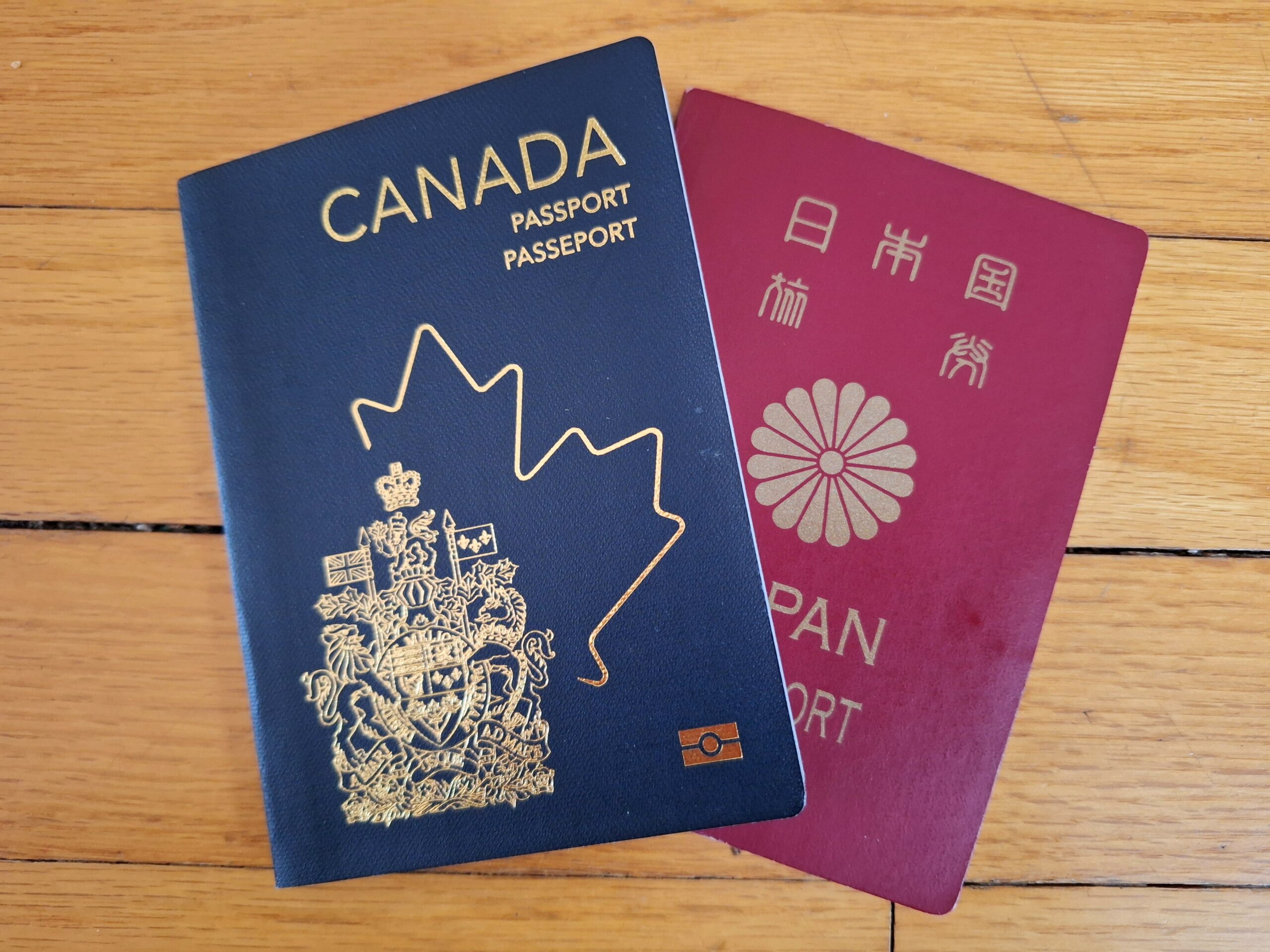
When Mai and I first travelled together to the UK in 2016, the digital transition was just beginning. Since then, we’ve enjoyed years of seamless, paperless entry. But in 2026, the rules have taken their biggest leap yet.
The mandatory UK ETA is now officially part of the journey. And if you’re relying on 2025 info, take note: the fee just doubled to £20 April 2026.
Whether you’re a first-timer or a regular like us, getting your digital prep right is the difference between a smooth landing and a headache at the gate. Here’s our 2026 insider guide on navigating the new ETA, the ePassport gates, and starting your British adventure without a hitch.
*Looking for the Japanese version of this guide? You can find Mai’s detailed post here: Read in Japanese: イギリス入国準備ガイド|ETA義務化とeゲート通過のコツ、取得したETAの確認方法
- Introduction: Digital Borders are Finally Here
- The New “Golden Rule”: Everything You Need to Know About the ETA
- Already Have an ETA? How to Check if It’s Still Valid
- Arrival at Heathrow: Mastering the ePassport Gates
- Customs & Carrying “Gifts”: What’s Actually Allowed?
- Beyond the Airport: Our Tips for 2026 UK Travel
- Conclusion: See You at the Pub!
Introduction: Digital Borders are Finally Here
If you’ve visited the UK in the last decade, you’ve likely noticed the steady disappearance of the “old ways.” Since Mai and I started our UK travels back in 2016, we’ve witnessed a quiet revolution at the border. The days of queuing is now normally replaced by the cool blue glow of ePassport gates and instant facial recognition (depending on your passport).
But 2026 marks the final piece of the puzzle. The UK has officially moved to a “Digital by Default” border. This means that your right to enter is no longer just about the physical book in your hand; it’s about the invisible data tied to it.
Goodbye Landing Cards, Hello Digital Checks
If you’re anything like me, you probably have a habit of forgetting the most basic travel essentials. I’m notorious for never having a pen on me—whenever we land in a country that still requires those tedious paper forms, I’m always sheepishly leaning over to Mai to borrow hers.
But here is the best part about entering the UK in 2026: The “Pen Stress” is officially over. The process is now entirely digital.
However, keep in mind that while you no longer need a pen, you do need a plan. Because the check-in is now handled by invisible data, the “paperwork” has simply moved from the seatback pocket to your smartphone. It’s much more efficient, provided you’ve done your digital homework before reaching the airport.
Why We’re Sharing Our Personal 2026 Experience
Why listen to us? Well, between my British roots and Mai’s frequent visits since 2016, we’ve navigated every version of this system. We’ve seen the ePassport gates go from “experimental” to “essential,” and we’ve been tracking the ETA rollout since its first whispers in 2024.
We’re not just reciting government websites; we’re sharing the real-world experience of a couple who travels these routes several times a year. We know the quirks of the app, the reality of the new fees, and the best way to get through the terminal so you can get to your first pint (or cup of tea) as fast as possible.
The New “Golden Rule”: Everything You Need to Know About the ETA
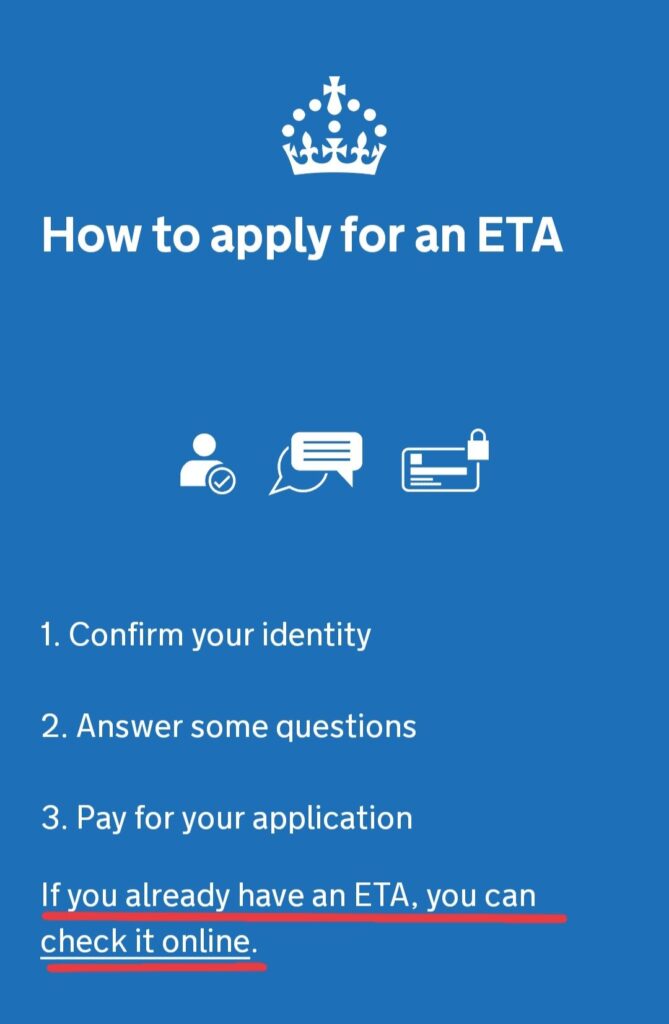
If there is one thing you take away from this guide, let it be this: No ETA, No Entry. In 2026, this isn’t just a recommendation; it’s a hard requirement. Think of it as your digital “key” to the UK. Without it, the airline won’t even let you board your flight.
What is the UK ETA and Who Actually Needs It?
The ETA (Electronic Travel Authorisation) is a digital permission to travel. It applies to visitors who don’t need a full visa—including our friends from the USA, Canada, and Australia, and travellers like Mai from Japan. Even if you’ve visited the UK a hundred times before without a single piece of paperwork, the rules have changed. As of 2026, everyone in the “visa-exempt” category must have this digital link attached to their passport before they arrive.
Price Update: Why It’s Now £20 (And How We Paid Less in 2025)
Here’s where you need to be careful with old information you find online. When Mai applied for her ETA back in late 2025, it was a bargain at just £10. However, the UK government updated the fees this past April, and the price is now officially £20.
It’s still a relatively small price for a two-year permit, but if you’re travelling as a family of four, that’s £80 you need to factor into your pre-trip budget. Don’t let an outdated blog post from 2025 tell you otherwise—make sure you have £20 ready on your card.
How to Apply via the App: A Quick Step-by-Step Guide
While you can use the website, I highly recommend the “UK ETA” app. It’s much easier than typing everything out.
- Scan your Passport: You just take a photo of the ID page.
- The “NFC” Trick: This is where the magic happens. You hold your phone against the passport, and it reads the chip inside. (If it doesn’t work the first time, try removing your phone case!)
- Face Scan: A quick selfie to prove you are who you say you are.
- The Questions: A few simple questions about your job and travel history.
- Pay: Use Apple Pay or a credit card, and you’re done.
The app is actually quite clever—it saves me from my own messy handwriting, which I’m sure the UK Border Force appreciates! Just make sure your phone is charged and you have a steady hand for that selfie.
Processing Times: Why “Last Minute” is a Bad Idea
Most people get their approval email within a few hours. Mai’s approval came through almost instantly. However, the official advice is to allow up to 3 working days. Don’t be the person trying to apply while standing at the check-in queue at JFK or Pearson. If there’s a technical glitch or your application needs a manual review, you could miss your flight. We always suggest getting it sorted the moment you book your flights. It’s one less thing to worry about while you’re packing!
It is a 100% “invisible” authorization
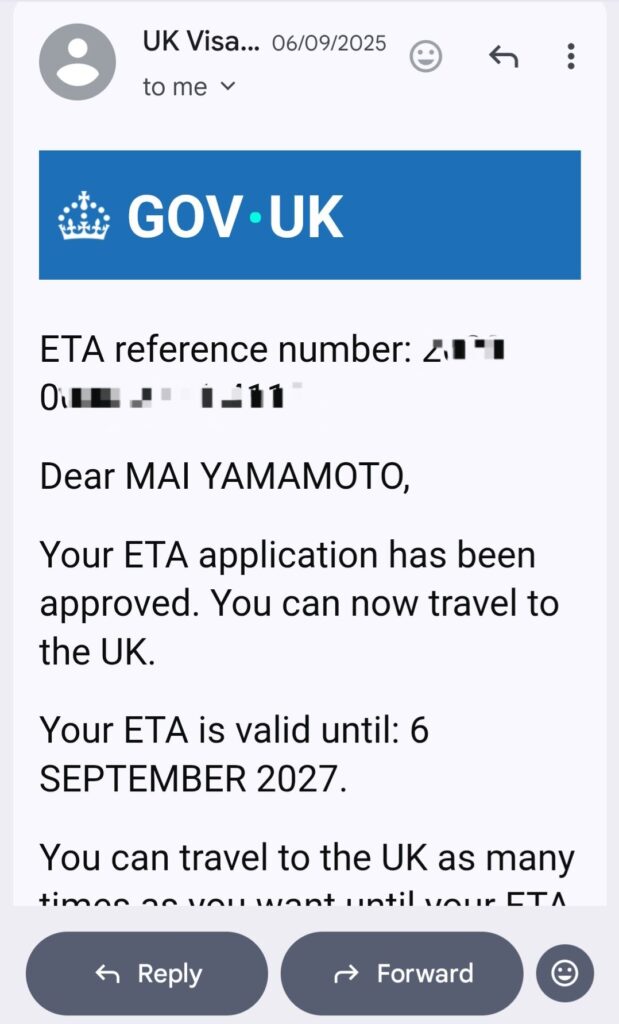
One thing that genuinely surprised Mai when she first applied was the lack of a “certificate.” Unlike some other countries, the UK does not issue a PDF file, a QR code, or any physical document for you to print out.
Because it’s digitally linked to your passport number, the airline’s check-in system and the ePassport gates already “know” you have permission before you even show your face. Mai found this lack of a paper trail a bit nerve-wracking at first—it’s a strange feeling to head to the airport with nothing but your passport! But rest assured, the system is designed to be seamless. You don’t need to print anything, and you don’t need to show a confirmation screen to the border officers.
Already Have an ETA? How to Check if It’s Still Valid
One of the most frequent questions we get is: “I travelled to London last year and got my ETA then—do I need to pay another £20 for my 2026 trip?”
The short answer is: Maybe. While the ETA is designed to be a “set it and forget it” system, there are two major factors that could render your current authorization useless. Here is how Mai and I double-check ours before every flight.
The 2-Year Rule vs. Your Passport’s Expiry Date
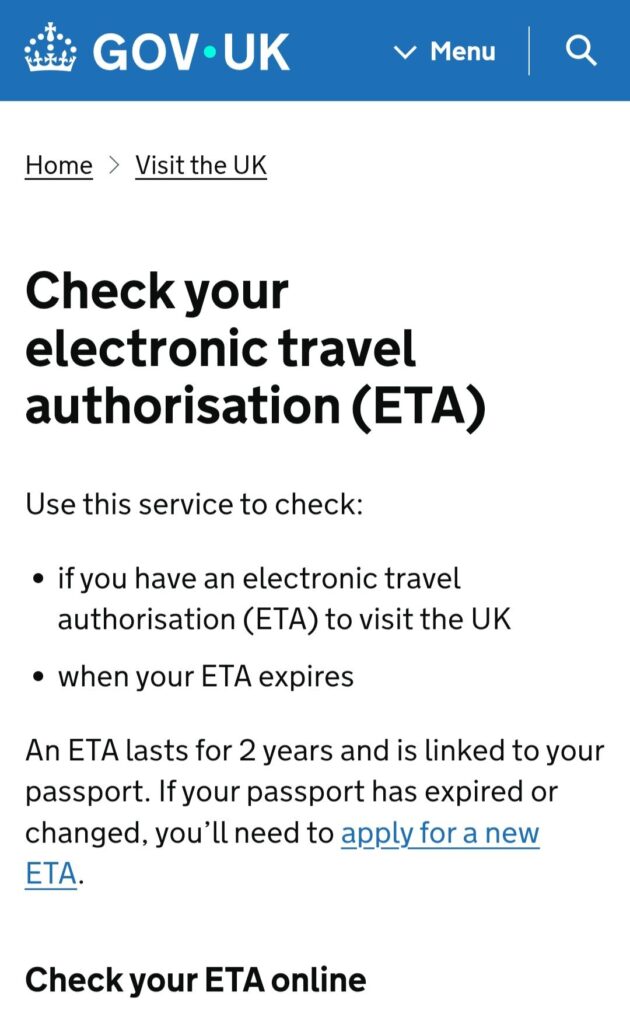
On paper, the UK ETA is valid for two years from the date of approval and allows for multiple entries. However—and this is a big “however”—the ETA is digitally “locked” to your specific passport.
- Scenario A: Your ETA was granted in 2025 and your passport doesn’t expire until 2030. You are good to go! Your 2025 ETA is still valid for your 2026 trip.
- Scenario B: You got a new passport because your old one expired, or perhaps you lost it and had it replaced. Your old ETA is now void. You must apply for a brand-new ETA (and pay the new £20 fee) with your new passport details.
In our case, Mai’s passport is still the same one she used for her £10 application in 2025, so she’s all set. I always tell my friends: Check your passport’s expiry date before you check your ETA.
Forgot Your Expiry Date? How to Check Your Status Online
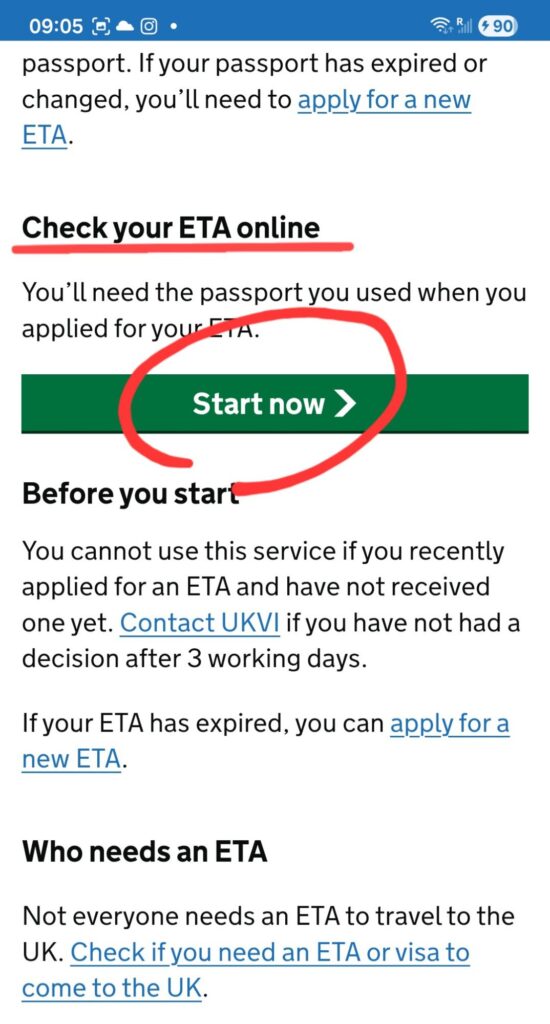
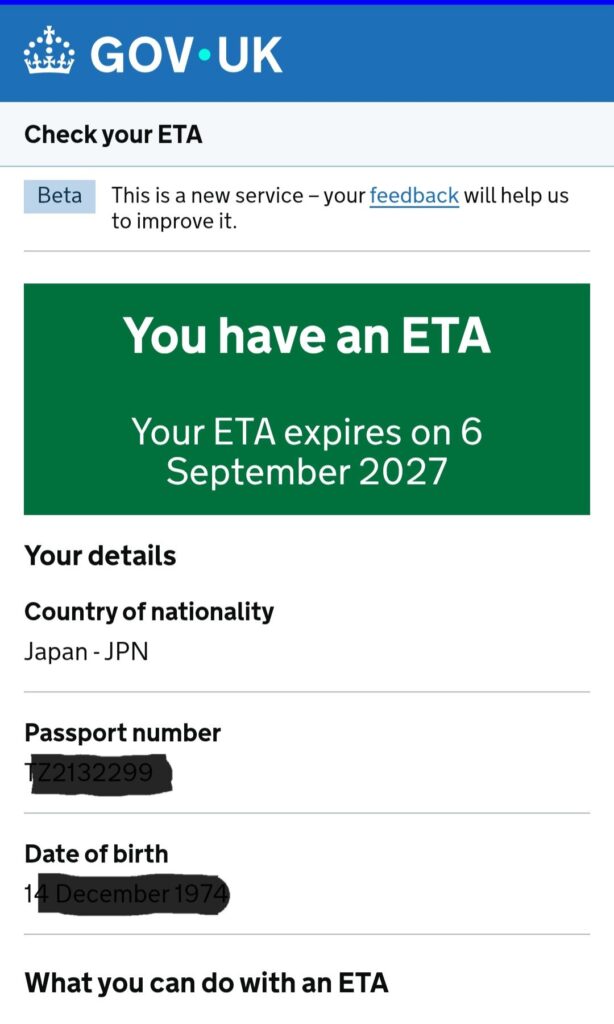
If you’re like Mai and secured your ETA back in 2025, you might be scratching your head trying to remember exactly when it expires. Since there’s no physical paper to check, it’s easy to lose track.
The good news? You can verify your status in about two minutes on the official GOV.UK website. You don’t need to dig through thousands of old emails—you just need the passport you used for the application.
How to check your ETA validity:
- Go to the official Check your ETA status page on GOV.UK.
- Click “Start now” in the section “Check your ETA online.”
- Enter your Passport Number, Passport Expiry Date, and your Date of Birth.
- The system will instantly pull up your record and show you the exact date your authorization expires.
Arrival at Heathrow: Mastering the ePassport Gates
Once you step off the plane at Heathrow, the race to the finish line begins. For most of us, that finish line is the ePassport gates. Since 2016, these gates have become the standard way to enter the UK, and in 2026, they are faster and more reliable than ever.
Looking for the “日の丸” (Sun) and Other Friendly Flags
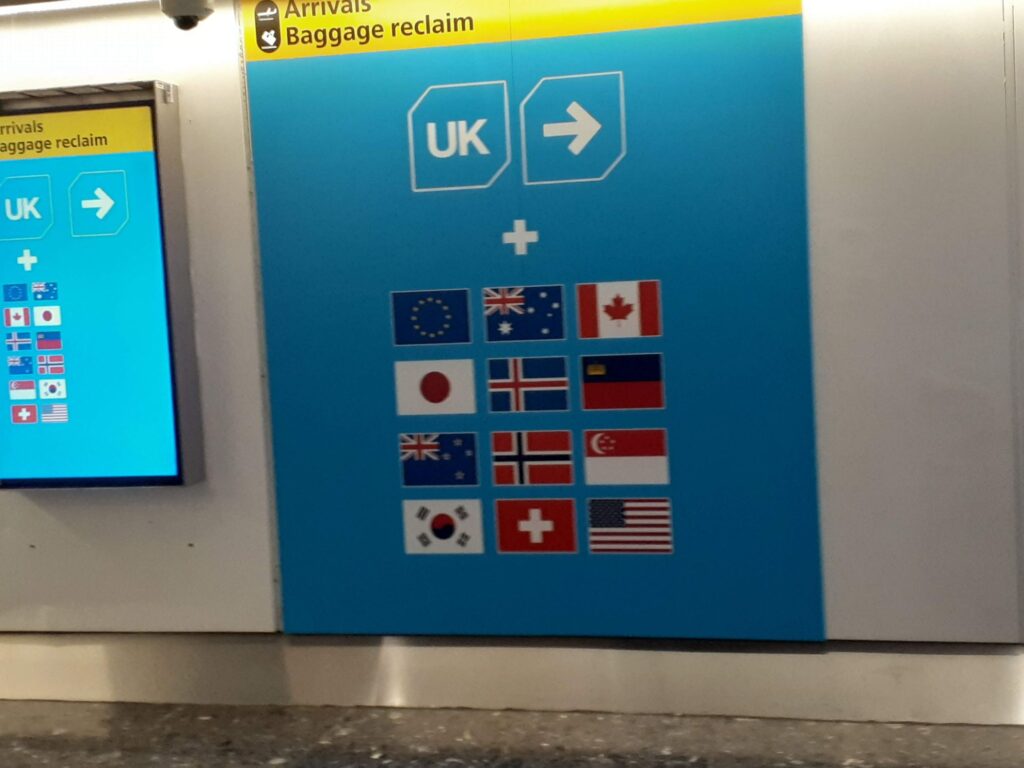
As you follow the “Arrivals” signs toward Border Control, you’ll see large purple signs for the ePassport gates. You don’t need to join the long, winding queue for a manual desk. Look for the digital screens displaying the flags of eligible countries.
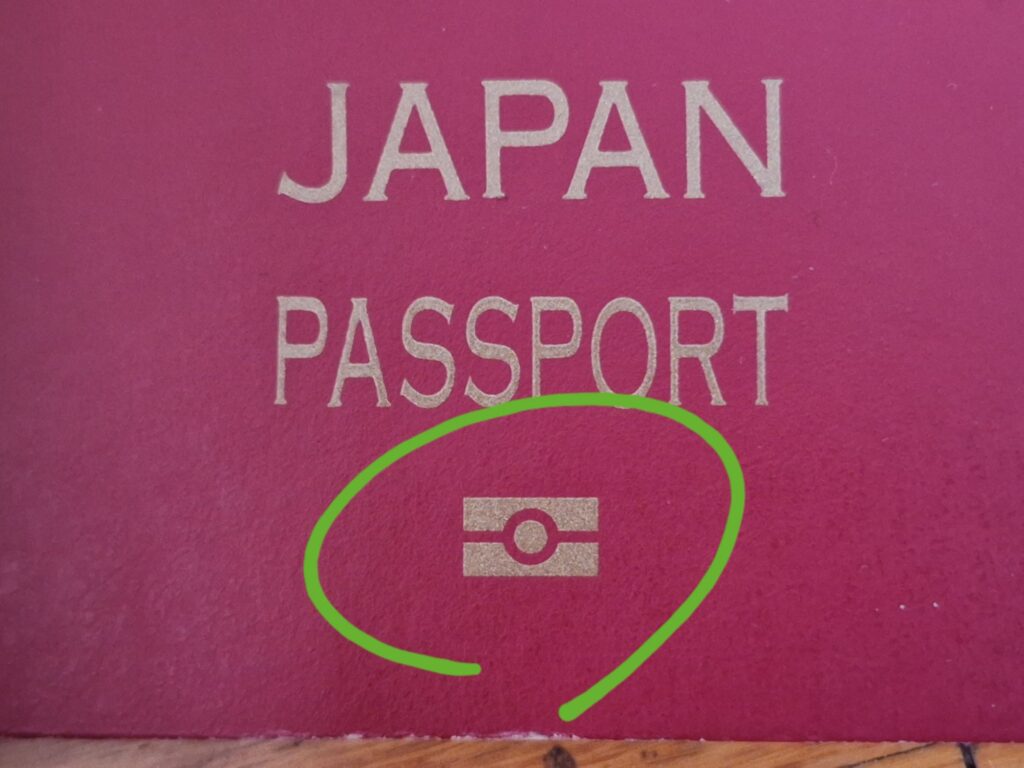
You’ll spot the Rising Sun of Japan, the Maple Leaf of Canada, and the Stars and Stripes of the USA, among others. If your flag is up there and your passport has the “biometric” symbol (the little camera icon) on the cover, you’re in the right place.
How to Avoid the “Red Light” of Doom: Tips for a Smooth Scan
We’ve all seen it: the person in front of you gets the dreaded red light and has to be escorted to a desk by an officer. To make sure you get the green light every time, here is my personal “eGate Protocol”:
- Remove the Cover: If you have a cute passport case, take it off. The machine needs to read the chip and the photo page perfectly.
- Hats and Glasses Off: The cameras are looking for your facial structure. Even if your glasses are prescription, it’s safer to take them off.
- The “Still” Moment: Stand on the footprints, look directly at the screen, and stay still. It only takes a few seconds.
What Happens if You Get the “Red Light”? (Mai’s Real Experience)
Even if you do everything right, the eGate might still flash red. Don’t panic—it doesn’t necessarily mean you’ve done something wrong.
During our 2025 stay, Mai took two short side trips to Europe. When we returned to the UK for the second time, her eGate wouldn’t open, and she was directed to a staffed booth. We suspect the system flagged her simply because she was entering and exiting the UK frequently in a short period.
If this happens to you, stay calm. The officer will usually just ask a few standard questions about your trip and your ETA status. As long as you have your plans clear, it’s a very routine process.
If you’re planning multiple side trips from London to Paris or Rome, you might run into this. Just keep your cool and answer the officer’s questions honestly. It’s all part of the digital border’s security checks, and in Mai’s case, she was cleared and through in just a couple of minutes!
Travelling with Family? Age Limits for the eGates
If you’re travelling with children, keep in mind that age matters. As of 2026, children aged 10 and over can use the ePassport gates, provided they are accompanied by an adult. For families with kids under 10, you’ll still need to see a Border Force officer at the desk, but there is usually a dedicated family lane to keep things moving quickly.
Customs & Carrying “Gifts”: What’s Actually Allowed?
After the relief of clearing the ePassport gates, there is one final hurdle: the Customs hall. For many travellers, the “Green Channel” (Nothing to Declare) feels like a free pass, but in 2026, the UK has become much stricter about what crosses its borders—especially regarding food and high-value gifts.
The “Nothing to Declare” Myth: Limits on Cash and Souvenirs
Here is the best news for your 2026 arrival: If you have nothing to declare, you don’t have to do anything. Unlike many other countries that require you to fill out a digital customs form on your phone or hand over a paper slip to an officer, the UK operates on a system of pure convenience. If your luggage only contains personal items and gifts within the legal limits, you simply walk through the Green Channel.
There are no forms to sign, no apps to update, and no “Customs Receipt” to show. You just grab your bags and head for the exit. It’s the final step in what we call a “Zero-Friction” arrival.
When Should You Actually Stop?
The “Nothing to Declare” system is based on trust, but the penalties for getting it wrong have increased in 2026. You only need to stop and speak to an officer at the Red Channel if:
- Cash: You are carrying £10,000 or more (or equivalent) in cash, including coins, notes, or even signed traveller’s checks.
- The £390 Limit: You have brought in “other goods” (souvenirs, electronics, clothing) worth more than £390 in total.
- Note: If you have one single item worth more than £390, you must pay tax on its full value, not just the amount over the limit.
- Prohibited Items: You have any meat or dairy products from Japan or non-EU countries. The UK has ramped up its biosecurity checks in 2026, and even a small packet of beef-flavored snack can result in a fine.
- Alcohol & Tobacco: You have exceeded the specific allowances (e.g., 4 liters of spirits, 200 cigarettes).
The 2026 Reality: If you fall within these limits, you simply walk through the Green Channel. No paperwork, no digital forms, and no stopping. The UK Border Force uses advanced scanning and spot-checks, so as long as you’re within the rules, you can head straight to the arrivals hall without saying a word to anyone.
One Final Word: Always Verify Before You Fly
While we keep this guide as up-to-date as possible, customs and biosecurity rules in the UK can shift without much notice. A product that was allowed in 2025 might be restricted by the time you travel in late 2026.
To avoid any surprises (or the heartbreak of seeing your favorite Japanese treats confiscated!), we strongly recommend doing a quick double-check on the official GOV.UK Customs page a few days before your flight.
Beyond the Airport: Our Tips for 2026 UK Travel
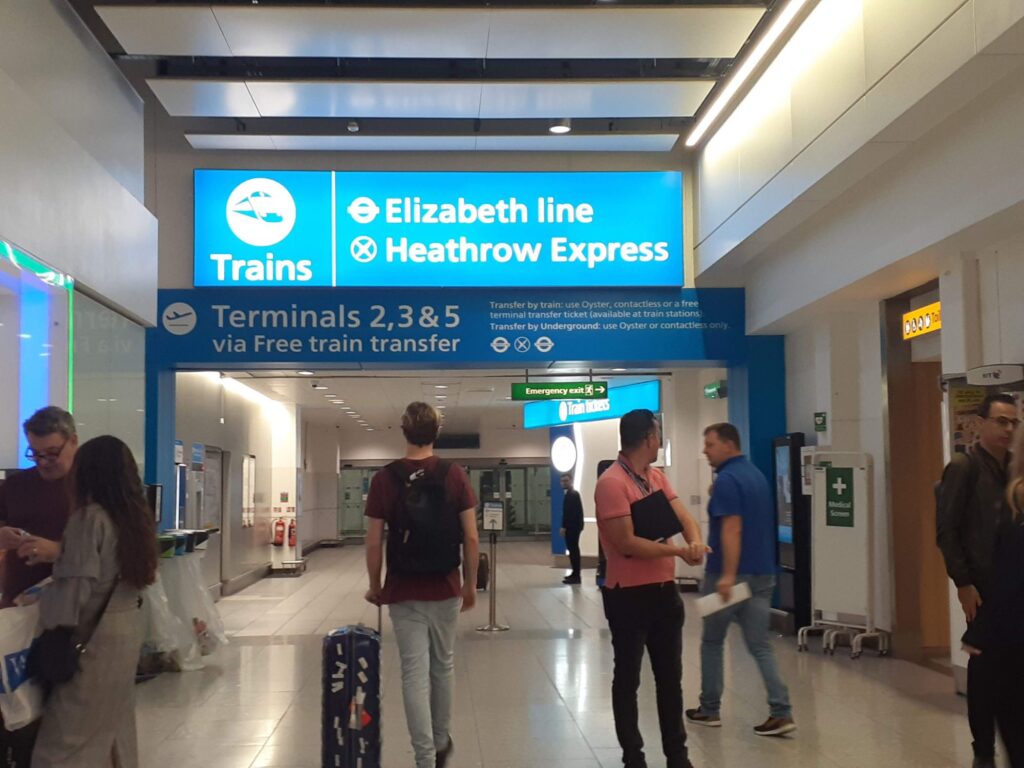
Congratulations! You’ve cleared the ePassport gates, walked through the Green Channel, and officially stepped into the UK. But as we’ve learned from our travels since 2016, the “digital” experience doesn’t end at the border. Here is how we’re handling our 2026 travels beyond the terminal.
The Coach Advantage: Moving Comfortably and Cheaply
While many people head straight for the Heathrow Express or the Elizabeth Line, Mai and I are big fans of the National Express coaches. If you’re heading to Victoria Station or another city entirely, it’s often the most stress-free way to travel with luggage.
In 2026, you don’t need to find a ticket desk or print a voucher. We always book our seats in advance online and simply show the QR code on our phones to the driver. It’s quiet, you get a guaranteed seat, and you can watch the British countryside roll by while you recover from your flight.
The Death of the Oyster Card?
If you’re staying in London, here’s a tip from the “old days” that you can mostly forget: You likely don’t need to buy a physical Oyster Card anymore. In 2026, the UK is almost entirely cashless.
We now use Contactless Payment (or Apple Pay/Google Pay) for everything—from the Tube and buses to the smallest coffee shops. Just tap your phone or card at the yellow reader, and you’re good to go. It automatically calculates the best fare for you, so you don’t have to worry about “topping up” a separate travel card.
Staying Connected: eSIM vs. The Classic Supermarket SIM
Since so much of the 2026 UK experience—from ETA status checks to bus QR codes—relies on being online, getting your data sorted is a priority.
For the fastest setup, we now recommend using an eSIM. You can activate it before you even leave Canada or Japan, and your data kicks in the moment you land. No more fumbling with plastic cards or paperclips!
But what if you prefer a physical SIM? If your phone doesn’t support eSIM, or if you’re looking for the absolute cheapest local rates, you can still do it the “old fashioned” way. One of the first things we often do is head to a Tesco, Sainsbury’s, or Boots. You can pick up a physical SIM card at the checkout for as little as 99p and then top it up with a data “bundle.”
Of course, that 99p is just for the card itself—you’ll then need to “Top-up” with a data bundle (starting from around £5–£10 for basic travel needs).
Note: I’m currently working on a dedicated post comparing the pros and cons of UK eSIMs vs. Supermarket SIMs (Tesco vs. Giffgaff, etc.), so stay tuned for that deep dive
Conclusion: See You at the Pub!
If you’ve made it this far, you’re officially ready to tackle the UK’s digital borders. Looking back at our first trips together in 2016, it’s amazing to see how much has changed in the world. We’ve gone from messy ink pens and paper landing cardsin some country’s to a world of biometrics and £20 digital authorizations.
It might feel a bit strange to travel with “invisible” permissions and no paper trail, but as Mai and I have discovered, once you embrace the system, it’s actually quite brilliant. By doing your “homework” (the ETA and your travel tech) before you leave your sofa, you’ve removed 90% of the travel stress before you even reach the airport.
The Final Goal: That First Pint (or Pot of Tea)
The whole reason we’ve mastered these digital shortcuts isn’t just for the sake of efficiency—it’s so we can get to the real reason we’re here as quickly as possible. Whether it’s a cozy pub in a tiny village or a bustling spot in the heart of London, there is nothing quite like that first “Welcome to Britain” drink.
So, double-check your ETA, confirm your passport is in your bag and get ready for an incredible 2026 adventure. The borders are digital, but the hospitality, the history, and the fish and chips are very much real.
We hope this guide makes your arrival as smooth as ours. If you see us on a National Express coach or at a Tesco SIM card rack, come say hello!
Safe travels, and we’ll see you at the pub!
— Chris & Mai

Comment