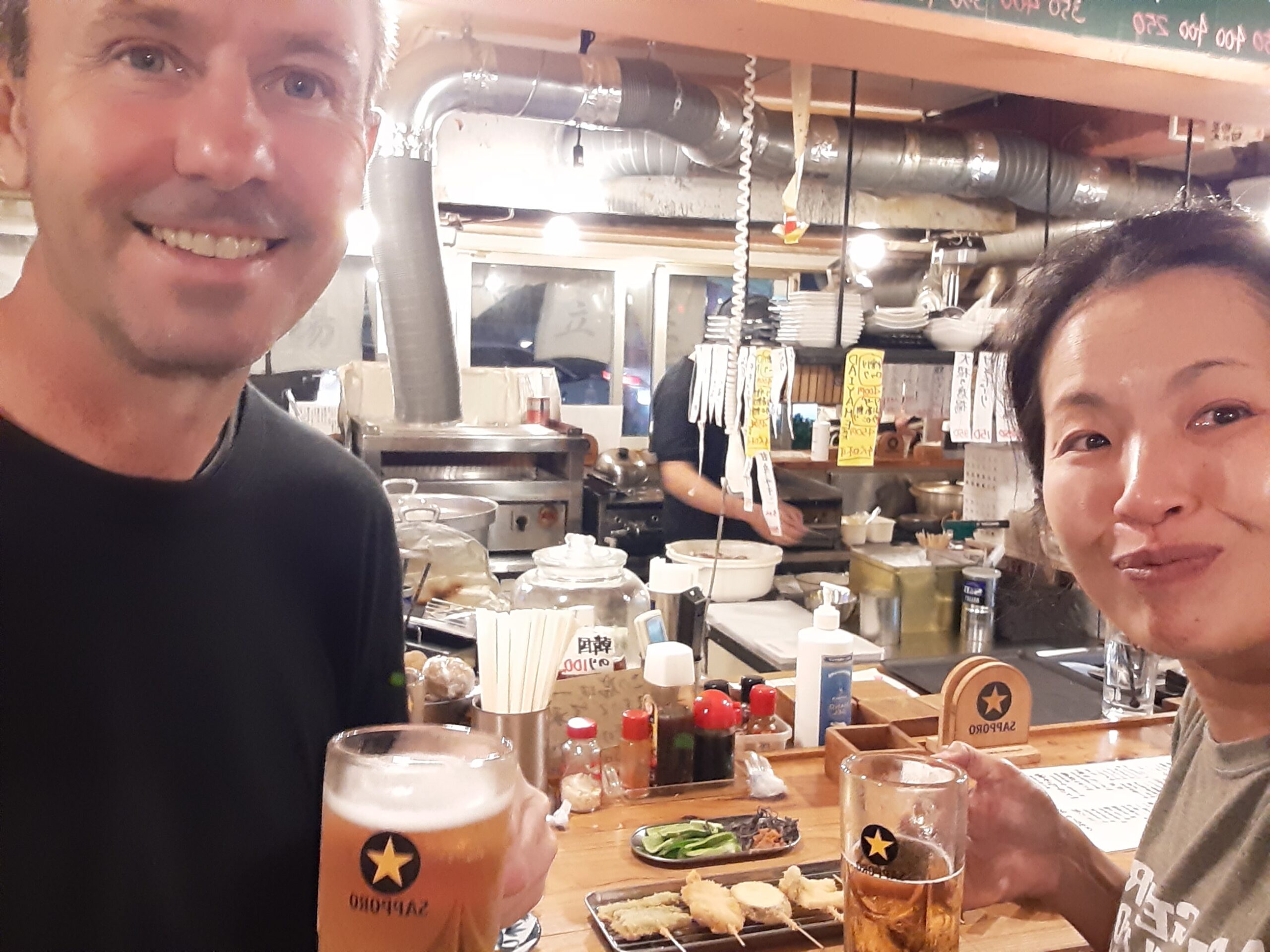
If you are currently planning a Japan travel itinerary and looking to dive into the authentic Tokyo nightlife or Osaka street food scene, you are probably excited to experience a traditional Japanese Izakaya and sample local sake. During your research, you might have also come across a fascinating cultural phenomenon: Tachinomi (Japanese standing bars) and standing eateries.
To many international travellers, the idea of a standing-and-drinking bar might feel a bit unusual—or even like a breach of dining etiquette. In fact, even my Japanese wife, Mai, grew up in Japan being strictly taught by her parents that eating on your feet was not really the done thing. Yet, when Mai and I explore the vibrant food alleys of Japan today, we see these standing spaces everywhere, packaged as the ultimate trendy, high-quality, and deeply social culinary experience.
Far from being a sign of declining manners, this style of dining is actually one of the coolest trends in the country. But how did a style of dining that once clashed with traditional household upbringing become a must-visit highlight for any Japan food tour? Let’s dive into the fascinating history and modern appeal of Japan’s standing food culture.
The Historical Roots of Tachinomi: Old Tokyo’s Fast Food Culture
To understand why standing to eat is acceptable in Japan, we have to travel back to the Edo period (1603–1867). While formal samurai banquets and family meals strictly required sitting on tatami mats, a completely different culinary world was developing among the bustling working-class population of Edo (modern-day Tokyo).
Edo was a city filled with busy, single male labourers who needed quick, affordable, and substantial sustenance between shifts. This demand gave rise to a vibrant outdoor food stall culture (Yatai)—the birth of Japanese fast food.
Yatai stalls where people stood to eat were the original fast-food joints of old Tokyo. Interestingly, many of Japan’s most celebrated dishes today were actually designed to be eaten quickly as casual finger food or standing snacks straight from a street stall:
- Sushi: Originally sold as large, hand-rolled rice balls topped with fresh fish from the bay, grabbed with your hands for a quick bite.
- Soba Noodles: Served in hot broth for a fast, stand-and-gulp energy boost.
- Tempura: Deep-fried directly in front of the customer and eaten piping hot with fingers or chopsticks, long before it became a refined sit-down restaurant meal.
Therefore, when you visit a modern standing sushi bar or a station noodle shop, you are not witnessing a breakdown of modern manners. Instead, you are participating in a centuries-old culinary tradition that dates back to the historical roots of Tokyo’s street food.
Related Articles:
➡ What is Kakuuchi? Beginner’s Guide to Japan’s Cheapest & Most Authentic Bar Experience
➡ The Practical Beginner’s Guide to Tachinomi & Kakuuchi: How to Sip, Order, and Blend In Like a Local
➡ A Beginner’s Guide to Sake in Japan: What to Drink, How to Choose & Where to Go
From Salaryman Fuel to “Showa Retro” Standing Bars
As Japan industrialised during the post-war era and the economic boom of the late 20th century, the standing food culture evolved to fit the needs of a new generation: the busy salaryman.
Efficiency and speed became paramount. Standing noodle shops popped up on railway platforms, allowing commuters to finish a hot bowl of soba or udon in the mere minutes between train transfers. Similarly, Tachinomi (standing-and-drinking bars) sheltered beneath train tracks, offering workers a place to grab a cheap, quick drink before catching the last train home.
For decades, these spots were seen as utilitarian, slightly gritty, and mainly the domain of older working-class men.
However, a massive cultural shift has occurred in recent years. Younger generations and international visitors have rediscovered these spaces, driven by a love for “Showa Retro” (nostalgia for the 1950s–1980s Japan). What was once seen as just a fast way to get a meal has been revitalised into an incredibly atmospheric, authentic cultural experience where people seek out the vintage charm of old-school neon signs and wooden counters.
Why the Standing-and-Drinking Trend Fits Modern Lifestyles
So, why is this trend exploding right now? It comes down to a perfect alignment with modern values and changing lifestyles.
1. The Power of “Taipa” (Time Performance)
In modern urban Japan, consumers highly value Taipa—the concept of time performance or efficiency. Sitting down for a formal, multi-course dinner requires a commitment of several hours. A standing bar or restaurant, by contrast, offers ultimate flexibility. You can walk in, enjoy a high-quality bite and a drink, and leave within twenty minutes.
2. Exceptional Quality at Fair Prices
By eliminating chairs, restaurants can dramatically increase their customer turnover rate and fit more patrons into small, premium urban spaces. This smart business model allows establishments to lower their overhead costs and reinvest that money directly into premium ingredients. Today, you can find high-end standing steak joints and artisanal standing sushi bars serving Michelin-grade seafood at a fraction of the price of a seated restaurant.
3. Breaking Down Social Barriers
Sitting at a private table creates a physical boundary between you and the rest of the room. In a standing bar, those walls completely disappear. The physical proximity naturally encourages casual conversation, making it incredibly easy to chat with the bartenders or rub shoulders with other diners. It offers a sense of vibrant, micro-community that is hard to find in conventional restaurants.
The Etiquette of Japanese Standing Bars: Standing Still vs. Walking
While standing to eat at a designated shop is highly celebrated, there is still one crucial distinction to bear in mind when travelling in Japan: standing at a designated shop or stall is perfectly fine, but walking while eating down a public street is generally considered bad manners.
Strolling down a crowded public pavement with a snack or a drink in hand is widely frowned upon. It poses a risk of bumping into others, staining clothes, and creates a litter problem since public bins are incredibly rare in Japan. Whenever Mai and I grab a quick bite from a convenience store or a small street vendor, the polite convention is to stand right next to the shop, finish it there, use the vendor’s bin to discard the trash, and then resume walking.
On the other hand, there are certain lively exceptions where eating while walking is completely accepted and even part of the fun. During local summer festivals (Matsuri), or when navigating specific street-food-focused market alleys, drifting from stall to stall with a skewer or a drink is a big part of the festive experience.
Ultimately, Japan’s food culture is beautifully multi-layered. It gracefully balances the refined, slow-paced etiquette of traditional seated dining with the vibrant, casual, and historical energy of the standing style. Visiting a Tachinomi or a standing eatery isn’t bad manners—it is an invitation to experience Japan’s most authentic, lively, and delicious everyday culture.
Related Articles:
➡ What is Kakuuchi? Beginner’s Guide to Japan’s Cheapest & Most Authentic Bar Experience
➡ The Practical Beginner’s Guide to Tachinomi & Kakuuchi: How to Sip, Order, and Blend In Like a Local
➡ Back to Japan Food & Drink Guide
Comment